INFRADESCONEXÃO
AN ART-BASED RESEARCH

SUBMARINE CABLES ON MACUMBA BEACH
In October 2017, Macumba Beach suffered a landslide that affected the anchoring area of submarine cables off the coast of Rio de Janeiro. The collision between the advancing sea and the invisible infrastructure of the connection points to a future in which coastal erosion also can affect the circuits of global communication.
TELECOMMUNICATIONS TOWERS ON SUMARÉ HILL
In October 2024, Sumaré Hill was the site of a fire that lasted more than 24 hours, threatening towers that support the city's radio and television signals. With the amplification of extreme events, the antennas that currently distribute information may become silent ruins in the wake of hot winds and soot.


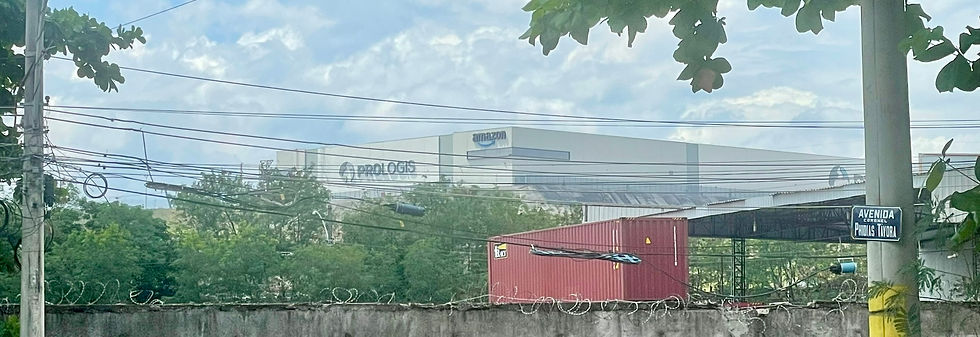
DATA CENTERS NEIGHBOURING PAVUNA RIVER
At the beginning of 2024, the Pavuna River overflowed and caused one of the most severe floods ever recorded, affecting logistics hubs and data centers in the region.
When water breaches the backstage of connectivity, it exposes the cracks in a technological promise that still ignores the pulse of the margins.
How is the research conducted?
How is the research conducted?
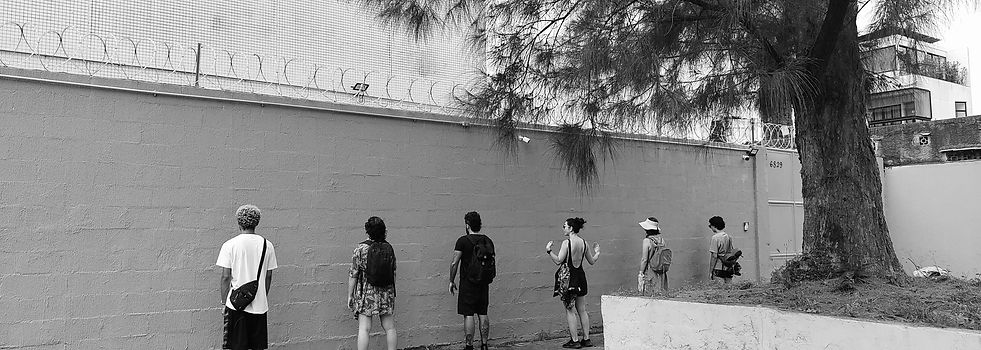
The research stems from the idea that environmental crisis and media infrastructures are deeply intertwined, especially when observed from vulnerable urban territories. To investigate this relationship, the research adopts an approach based on artistic and performative practices, recognizing creative gesture as a form of knowledge. The research seeks to inhabit infrastructural territories sensitively, provoking experiences, listening, and recordings that emerge from the body, the environment, and the network.
The actions take place initially in three territories of Rio de Janeiro marked by the presence of critical infrastructures (submarine cables, telecommunications towers, and data centers) and by recent environmental impacts (coastal erosion, forest fires, and urban flooding).
The research is organized through:
Situated practices, such as performative walks, workshops, visual and sound recordings, and experiments with the body in context;
Microfictions, glossaries, and visual essays that create sensitive ways of narrating the climate crisis beyond technical language;
Artistic and theoretical writings, in dialogue with fields such as communication, art, anthropology, and infrastructure studies;
A process-based online platform, nourished over the years with traces of these processes – images, sounds, texts, and affective cartographies.
More than representation, the project aims to experience the friction between climate and connection, producing embodied perceptions of a world that is increasingly unstable technically and environmentally.
Data centers, submarine cables, radio and television antennas are different types of media infrastructure. Together, they form a megastructure that supports the distribution of audiovisual signals and digital data, and whose operation is critical to the functioning of society in its various aspects. Despite this, media infrastructure is still a topic little studied by the humanities and social sciences.
The project developed here (with CNPq/FAPERJ support) begins to broaden discussions around the topic, drawing attention to the presence of these infrastructures in specific territories of Rio de Janeiro, as well as recognizing and highlighting the vulnerability of these territories and infrastructures to climate change.
The proposal involves visiting the territories and implementing a multidisciplinary approach based on artistic practices, sharing experiences and perceptions on the INFRADESCONEXÃO website. The aim is to recognize and deepen the relationships between climate change studies and critical infrastructure studies.

Such studies constitute research trends that, over the last decade, have gained increasing international attention precisely because of their urgency across fields such as geography, communication, anthropology, sociology, engineering, the arts, political science, among others.
Although infrastructures mediate our perception of environmental conditions, there remains a lack of cultural intelligibility regarding how climate and infrastructures sustain contemporary conditions of existence and ways of life and how both may collapse simultaneously in the near future. In 2021, the United Nations released a report specifically dedicated to the need and urgency of thinking through the relationship between infrastructure and climate change, with particular attention to the transformative potential of digital communication infrastructures.
Media infrastructure studies have developed by drawing critical attention to the materialities of media distribution — its resources, technologies, labor, surrounding environments, as well as the relations that shape, energize, sustain, or become entangled in the global, national, and local distribution of signals. More broadly, this movement makes it possible to recognize how these elements operate both as material forms and as discursive constructions, following routes inherited from the colonial past and being installed in territories and ecologies marked by turbulences of different orders.
These studies constitute research trends that have gained increasing international attention in the last decade precisely because of their urgency in areas such as geography, communication, anthropology, sociology, engineering, arts, political science, among others.
Media infrastructure studies have been conducted by drawing critical attention to the materialities of media distribution—its resources, technologies, jobs, environments, as well as the relationships that shape, energize, sustain, or become entangled in the global, national, and local distribution of signals. The movement allows us to recognize, in general terms, how these elements operate both as material form and as discursive construction, following routes from the colonial past and being installed in territories and ecologies marked by turbulences of various kinds.