SQUAT FIRE TRANSMISSIONS
TELECOMMUNICATION TOWERS IN SUMARÉ HILL
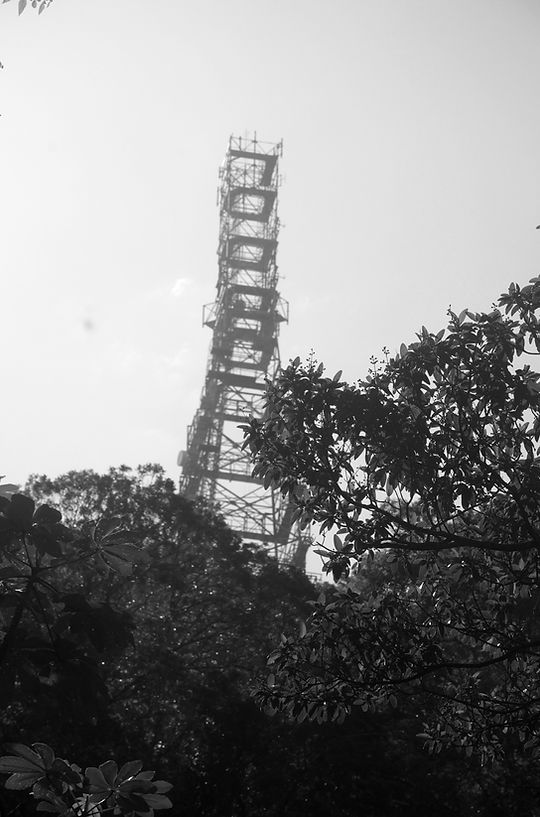
Since the 1950s, the landscape of Morro do Sumaré, Rio de Janeiro, has been marked by the installation of 18 telecommunications towers, authorized to meet the growth of the city of Rio de Janeiro. However, the initial lack of oversight led to significant environmental impacts, such as deforestation and instability on the slopes, aggravated by the unplanned use of the area.
From 1981 onwards, a process of "ordering" began to reconcile environmental conservation and technological activity. Management plans sought to reduce environmental damage and gradually remove obsolete structures, but the conflict persists and has intensified in recent years. Companies resist to this day, arguing that replacement would only be viable with equivalent technologies in other locations.

Fonte: Biblioteca Nacional. IN: Quental, Alice de San Tiago Dantas, and Marcos Favero. "As Ruínas do Sumaré." Revista Prumo 6, no. 09 (2021): 16.
MICROFICTION
An art installation created by an anarcho-survivalist group around a squat in the ruins of Parque do Sumaré is activated to protect the forest from fires on a summer day in 2035.

SPECULATIVE FUTURES AND SUMARÉ RUINS
This microfiction was imagined based on a future speculated by Sion and Favero (2021) in the article "The Ruins of Sumaré".
The text explores the historical conflict between ICMBio (the Chico Mendes Institute for Biodiversity Conservation) and the telecommunications towers on Morro do Sumaré, proposing an alternative to ICMBio's effort to completely remove the infrastructure.
Instead of opting for simple dismantling, the article suggests reinterpreting the towers and other ruins as part of a public park. The proposal aims to incorporate the infrastructure into the landscape, preserving its historical memory and transforming it into elements that dialogue with nature and the city. This space could offer areas for social interaction, environmental education, and new uses, highlighting Sumaré's trajectory as a symbol of the interaction between technological progress and conservation.
In the microfiction developed here, we imagine that the park was built, abandoned, and reoccupied by an anarcho-survivalist group in a dystopian climate future scenario.

Sumaré Park as presented by Quental, Alice de San Tiago Dantas, and Marcos Favero. "The Ruins of Sumaré." Prumo Magazine 6, no. 09 (2021): 16.

EMBODIED EXPERIENCE
Sumaré Espiralar
At the end of October 2024, I climbed Morro do Sumaré, in the North Zone of Rio de Janeiro, during a wildfire that engulfed the forest and took more than 24 hours to extinguish. The smoke was already visible from afar. As I approached the trailhead, I encountered firefighters, some volunteers, and residents observing from a distance. The atmosphere was tense as the fire advanced and ashes fell from the sky.
The initial plan was to observe and listen. I took a recorder, lightweight video equipment, and basic protective gear. As I climbed, it was possible to hear the crackling of the vegetation burning slowly. It wasn't a rapidly spreading fire, but rather a persistent one, consuming little by little. The trail was empty. Few people dared to enter at that moment.
Once inside the forest, I found a woman sitting on a low rock. She didn't introduce herself. She simply began to speak. The recording that resulted from this encounter is what gave rise to the sound piece "Sumaré Espiralar". Her speech, a mix of account and outpouring, shifted in time: she spoke of the current fire, but also of past events, of people who replanted the forest in the 19th century, and of an art installation activated there in the future—in 2035.
During the recording, other ambient sounds were also captured: wind, leaves, electromagnetic interference, distant urban sounds.
At one point, an automated voice emerged from a nearby device:
“Defensive system activated. Free forest protocol initiated.”
The contrast between this mechanical speech and the woman's voice was striking.
After the recording, I spoke with other people near the base of the hill: a forest ranger, residents who were coughing and fearing for their homes. The testimonies presented an overlapping of interpretations about the fire—from negligence by public authorities to the idea that it was all part of an "experimental artistic action."
OBSOLETE PUBLIC PARK
ANTI-FIRE ART
SIX ENSLAVED PEOPLE REFORESTED
ANARCHO-SURVIVALISM
FOREST PROTOCOL
INFRAMINCES FOR SOLSTICE
A PROPOSITION BYJÚLIA BRASIL
I would like us to communicate through metabolic pathways…
…words, particles, senses, food, vapors, residues, electromagnetic waves, seismic movements, stardust…
everything that is in me now has been somewhere else before
“YOUwillbecoME” [1]
A metabolic proposition articulates ambiguous, minimally affective experiences perceived only in contrast. An atmospheric change, the ingestion of something, planetary movements. Small spaces in between, almost imperceptible, but which, when noticed, operate the opening of an organic line. [2]


23,5 Degress C [3]
The earth is slightly tilted in relation to the sun, and therefore, with each revolution cycle, we have periods in which certain parts of the earth receive different amounts of sunlight and heat. [4] We use words like summer, winter, hemispheres, axes… Astronomical terms that help us describe this phenomenon. Different peoples in different parts of the world mark the moments of transition from one cycle to another with rituals. It was Ruy who drew attention to the solstice, recalling the practice of indigenous peoples of walking to the top of mountains and leaving offerings to the earth. Thus, we would perform a solstice action, not because we want to appropriate any ancestral practice, but because we continue to be beings of this planet, influenced by its vital cycles — even if distanced from them by modernized modes of life reproduction. Because solstices operate openings to our cosmic origin


THE BROTH


air conditioning – fans – heaters – antennas – submarine cables – alligators – papaya trees – anise – mate – coca – data – water – cloves – cinnamon – sunflowers [5] – heat – monkeys – tourists
The proposal was that we continue the reading experimentally, sensorially, metabolically, operating lines between Starosielski, us, Rio de Janeiro, BRISAlab and whoever else appeared in this mix.[2]
We appeared, me (Julia Brasil), Ruy, Bruno Amadei and Gilberto Vieira. On this day [7] we decided to walk to the Sumaré transmission park [8]. We walked attentively to small changes, to the possibilities that could appear along the way, to the reactions of our cosmic body always in formation. We reached our destination at 12 pm exhibiting a solar technique, even though we hadn't planned any of this.
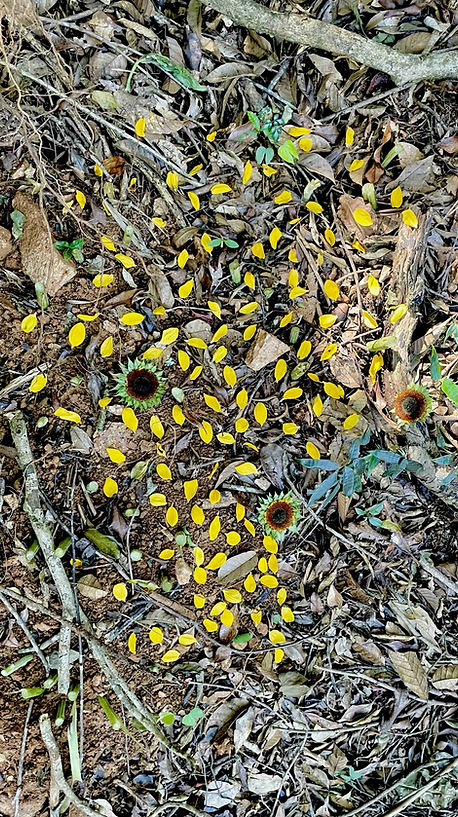
We couldn't get through the gates that control access, so there, at the entrance to the transmission park, we did a thermal meditation [9]. Then we shared a hot broth, with mate, cloves, anise and coca [10]. After that we chose a place to leave the sunflowers, brought by Ruy. We scattered its parts on the edge of the forest, yellow dots amidst the green of the forest that seemed to float. I believe that our offering to this mountain was also our heat, our vapors, our accelerated breathing, our sweat, our shivers, our pores – sometimes releasing, sometimes absorbing moisture, giving and receiving heat – particles entering through the respiratory tract, other particles from within our bodies that we left along the way. All this leaves a trace on the verge of disappearing [11]. Infralight [12] for the solstice was ourselves.
The solstice is the celebration of a movement that distributes heat across planet Earth. This distribution, which changes and repeats cyclically, generates distinct environments, defining ecosystems, cultures, etc. In other words, a constant taking-form [13]. If we think of “the body as an ecology of operations that extends the flesh of its matter and the environmentality of its multiple taking-forms.” and “technique not as a supplement to a pre-existing body-form, but as a process of embodiment (...) an in-formation of a mutating body” [14]. We can then say that this body (which is a field of relations) has a technique [15]. The massive ensemble of Tijuca, Sumaré hill, road, forest, us — we are lags [16] of this technique. We are part of this cosmic broth that presents itself in infinite ways.
The body here goes from a biological organization to a cosmic order. The heat distribution diagram, which operates from subatomic levels to beyond-cosmic levels, from the farthest-outside to the farthest-inside, traverses, makes, unmakes and remakes bodies, membranes, strata… We, that heterogeneous broth [17] of multiple interests, experience in our action this technique of heat on different scales and in different regimes, chemical, intellectual, physical, affective, sensory, historical, cultural, sociological, ritualistic, discursive, biological, physiological, environmental, geological, technological, sensitive, political…
We are constantly exchanging heat, human and non-human beings, minerals, stars and the totality of things that make up the world. This exchange is a form of communication that uses heat as a medium, not always voluntary, sometimes not even perceived. Infraleves for the solstice was an attempt to make—with this constant exchange of heat [18] and operate cuts that allow us, even if briefly, to access this plane of immanence.


1. Ricardo Basbaum writes about the transformation (and not just displacement) of the spectator from passivity to subject of their own experience. “Clark and Oiticica’s pieces can be considered sensory extensions in two ways: first, in the sense of expanding consciousness, generating an additional amount of sensory enhancement that leads to transformative effects on the body-mind. Lygia Clark writes about a process of “symbolic metabolism,” which means that the transformation is not metaphorical: the body/object interface (via the sensory dimension) operates an amalgam of organic-conceptual signs that create new functions in the body. Secondly, in the sense of producing a different type of time-space through the expressive activity of the participant-work, conceived by Oiticica as “inter-corporal.”” BASBAUM, Ricardo. Clark & Oiticica. Available at: https://www.forumpermanente.org/administ/revista_ho/ho_basbaum
2. Lygia Clark's organic line refers to a line that is not purely formal, but rather an opening, a fissure, or an incision that creates a connection between different elements, whether in a painting, a sculpture, or even in architectural space. It is a line that invites exploration, sensory perception, and interaction of the observer with the work, breaking with the idea of a finished and static work of art. "The artist can also investigate lines that function as doors, as connections between materials, such as fabrics, etc., in order to modulate an entire surface." According to Luis Perez-Orama, "the reason she calls the organic line 'organic' is not because it looks like a curve or a biologically inspired line. No… It's because it gives you the possibility of looking inside the body of the painting. It's because it's made as an incision in the body of the painting. Therefore, it functions as an opening to the organism of the painting."
3. 23 degrees is the planet's tilt relative to its axis. Could it also be the temperature of a winter in Rio de Janeiro? Latitude? Longitude? Degrees of separation?
4. This value is known as obliquity and is one of the Milankovitch orbital parameters. Although the other parameters, eccentricity and precession, also affect the distribution of heat on the planet, "the obliquity (tilt) of the Earth's axis of rotation relative to its orbital plane is the most important factor for the annual temperature cycle." (...) "The obliquity of the axis of rotation is practically stable, as it oscillates only between 22.1º and 24.5º, in periods of about 41,000 years (the current value of the obliquity is 23.5º), and this stability is maintained by the torque exerted by the Moon": REBOITA M.S., Pimenta A.P. and Natividade U.A. 2015. Influence of the Earth's axis of rotation tilt on global air temperature.
Terræ Didatica, 11(2):67-77. <http://www.ige.unicamp.br/terraedidatica/> p. 69
5. Sunflowers are native to the territory we now call Mexico and the United States and were domesticated by indigenous peoples.
6. Here it is necessary to point out the Performance as Research (PaR) methodology. BrisaLAB, the group to which we both belong, coordinated by Walmeri Ribeiro and Ruy Campos Figueiredo, uses this as a starting point for its actions. About BrisaLAB see: https://brisalab.com/apresentacao/. About PaR see: RIBEIRO, Walmeri. Sensitive territories: ecologies and emerging bodies in situated artistic practices. Revista Visuais, Campinas, SP, v. 9, n. 1, p. 64–75, 2023. DOI: 10.20396/visuais.v9i1.18304. Available at: https://econtents.bc.unicamp.br/inpec/index.php/visuais/article/view/18304. Accessed on: July 24, 2025.
7. June 21st marks what we call the solstice, here in the southern hemisphere, the winter solstice.
8. This choice has several reasons: first, because this territory is already part of Ruy's postdoctoral research, as it houses the Sumaré transmission antennas, communication infrastructure, in a territory affected by climate change. Secondly, because during my research process, I came across accounts from European travelers who came to the "new continent" to study and catalog animal and plant species. In these travelogues—which so greatly shaped the European view of this continent and its inhabitants—many references are found to the climate and temperature of the tropics, mostly pejorative. The Tijuca Forest was one of the points of interest for these travelers who disembarked at the port of Rio de Janeiro. I must say, however, that during the action, while walking through the forest, I realized that this territory also holds a place of affection for me. As we walked, I found myself getting to know the curves, the springs, the views of the city. The forest is a place I frequent weekly; I notice its changes, I can tell that on that day everything was very dry, that the wind in that place is normal. I don't frequent it as an artist-researcher, but we are always artist-researchers. Some time ago I made the connection of